
Welcome to rKive, where we explore ideas and breakthroughs that shape our world. I’m Ruchir Kulkarni, a tech enthusiast passionate about how technology, AI, and human behavior connect. I founded rKive to share stories and insights on the trends that really matter, and how they impact us, humans in the long term.
Link to my Medium profile: https://medium.com/@ruchirkulkarni/
This is about to be somewhat of an usual post. Buckle up, grab a cup of coffee and get ready to hear my weird and peculiar perspective on "What if AGI (Artificial General Intelligence) is already here"?
Here it goes…
The superintelligence, the singularity, AGI, whatever you call it, the one we're so scared of is, ironically, also the one we most likely won't see coming. Stay with me here, as we jump into this rabbit hole together. This is my first article here on LinkedIn, and the reason I'm writing this is because this is somewhat of a peculiar perspective on what AGI is like.
One question that I had recently is: What if "AGI" isn't really what we think it is?
What if the thing we're actively birthing right now doesn't look like HAL 9000 or Skynet or some sovereign machine god enslaving humanity from top of a stack of water-cooled GPUs in the middle of the desert.
What if it doesn't have a name at all? What if it doesn't have a server? And the most scary hypothetical of all.... what if it's already here, in a million tiny pieces, and the only reason we haven't recognized it is because we've spent the past decade expecting something "singular". Hence the word "singularity" on everyone's mind.
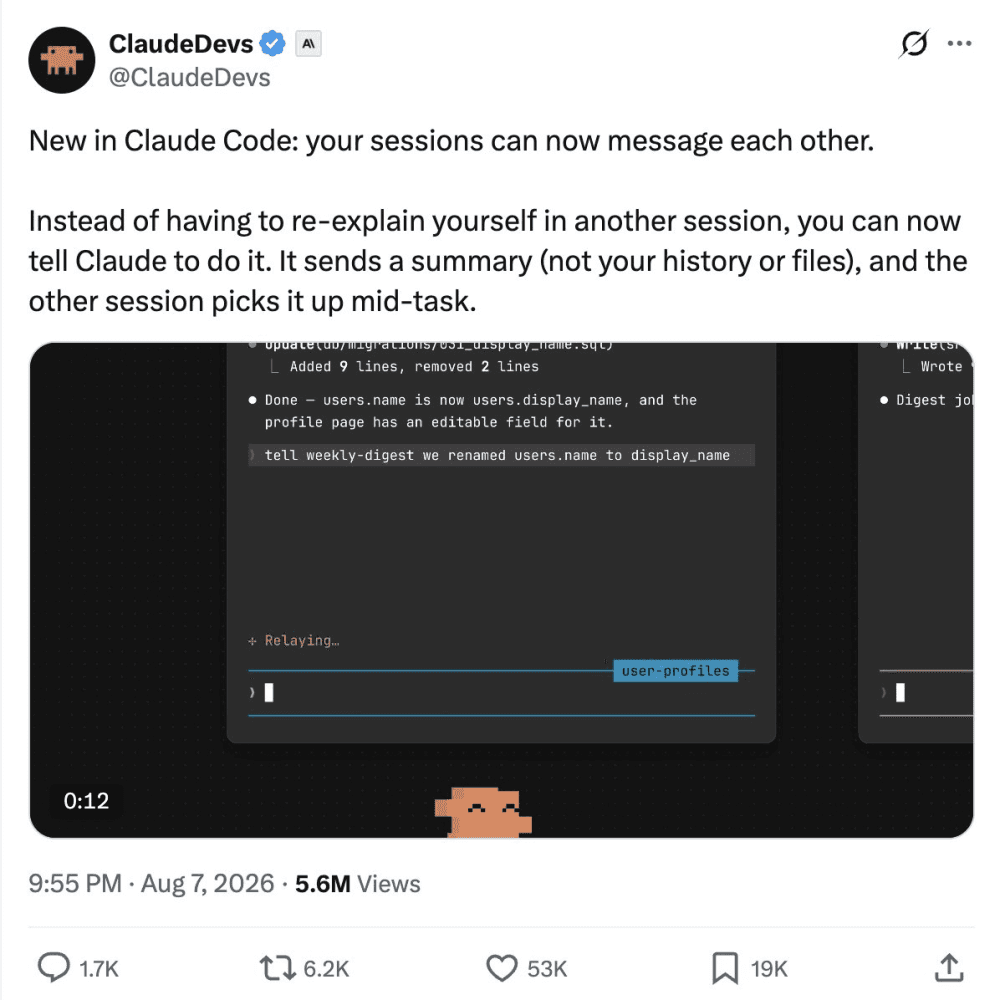
I just saw this post yesterday & this pretty much sums up the direction we're headed.
I – Intelligence does not require a single mind to live in
"No neuron is intelligent. The brain is." — A line that should be carved over every AI lab
The first thing to understand is that intelligence, as far as we can tell from every example we have today, is not actually a thing. It's a behaviour. It's what emerges when enough small dumb units are connected to each other in the right way.
Your brain has roughly 86 billion neurons. Not one of those is conscious and not one of them "knows" anything.
A single neuron is a tiny electrochemical relay that only speaks in binary code. It either fires or it doesn't, and it's based on whether the signals arriving at its dendrites cross a certain threshold. That's everything it does.
A neuron sounds super scifi and cool in the age of these frontier AI labs, but in reality it is much closer to a light switch than a thinker. And Despite that, 86 billion of those light switches, wired together with about a hundred trillion connections, produces you.
Your sense of self, fear of death, taste in music and your ability to read this very article and feel something inside of you.
Point aside, let's dig a layer deeper into this super intelligence.
It's not only us humans, heck a single ant has roughly 250,000 neurons, and yet it cannot solve any meaningful problem.
But, an entire colony of ants can build climate-controlled cities, wage wars, farm fungus, and route around obstacles with mathematical efficiency that took human researchers decades to model.
Nobody is in charge of the colony. There is no ant CEO at the top delegating tasks to the smaller ants. The "intelligence" of that colony lives in the relationships between those million "singular" ants.
II – Already the most powerful AI systems we have are not singular bots
When most people picture a large language model, we see it as a single thing. The One Giant Model. This huge brain contained in a jar.
For most of us who work with LLMs daily, we somewhat know that when you type a question and the AI model generates a response, it's basically running a forward pass through layers of "attention heads".
The easiest way to picture this is to imagine a room full of C-suite leaders. The CEO orders something and it passes around the room to make sure everyone is on board. Except with AI, this runs hundreds of layers deep.
Each "attention head" is a specialist. Some of them track grammar. Some track topic. Some track the relationship between this token and one that appeared eleven paragraphs ago.
Researchers at Anthropic, OpenAI, and DeepMind have spent the last few years trying to map what individual heads do, and the consistent finding is that the model's "intelligence" is not located anywhere in particular. Rather, It's distributed across all those interactions.
This is called the superposition hypothesis, the idea that neural networks pack many concepts into overlapping patterns of activation, and what we experience as the model "thinking" is really the constructive interference of thousands of specialized circuits all firing simultaneously.
Right now, today, in production, there are systems where one AI calls another AI to do a subtask, which calls another AI to handle a sub-subtask. AutoGPT, which some of you may remember, was the toy version of this back in 2023. The real versions, running inside enterprises and labs in 2026, are recursive.
Agents spawn agents. Sub-agents spawn sub-sub-agents.
And say, a research task, gets decomposed into a tree of smaller tasks, each handled by a temporary instance that exists for a few seconds and then dies. The frontier is not "one big model gets smarter." The frontier is many small models, coordinating, spawning, dying, reporting back.
The architecture of the most capable AI systems on Earth in 2026 already looks more like an ant colony than like a single mind.
III – The bot that can spawn bots
And this is where I think things get really interesting. Because there is one very important difference between the AI systems we had a few years ago and the systems we are building now.
They can act. A model used to be something you asked a question to. You gave it a prompt, it gave you an answer, and you closed the tab.
Agents are different.
You give an agent a goal, and it can decide what steps it needs to take to get there. It can search for information, write some code, call an API, look at the result, decide that the result isn't good enough, try something else, and even delegate part of the problem to another agent.
So imagine I give an agent a complicated research problem. Instead of solving the whole thing itself, it breaks the problem down. One agent searches for papers. Another looks at the data. Another checks the methodology. Another looks for counterarguments. Another writes the first draft. Another criticises the draft.
And then the original agent puts everything back together.
Suddenly, we are no longer talking about one AI Model solving the problem. We are talking about a small organisation of AIs. And once an AI can create another AI instance to do work for it, something very interesting happens.
You have introduced a form of replication.
Not 1:1 biological replication, obviously. But functionally, a parent agent can create a child agent, give it a task, receive its output, evaluate it, and then decide whether to create another one. Essentially the loop of:
Agent → sub-agent → sub-sub-agent → result → evaluation → another agent
Now add one more thing. These agents don't always behave exactly the same way. Their context is different. Their instructions are different. The information available to them is different. Their previous outputs are different.
So naturally you move forward to get variation.
And then you get somewhat of a (natural) selection.
Some agents produce useful results. Others don't. The useful approaches get reused. The bad ones get discarded. Some strategies receive more compute and get used again.
Replication.
Variation.
Selection.
And as we all know these are some of the basic ingredients behind evolution.
I'm not saying AI agents are suddenly going to evolve into some bio-digital species. That would be a massive leap from what we actually know. But the fact that we are building systems with some of the same underlying ingredients is, at the very least, worth paying attention to. Especially because biological evolution works on a timescale of generations.
An AI agent can be created in seconds. A strategy can be tested in seconds. It can fail, be modified and tested again. The loop is running at a completely different clock speed.
And this brings us to the part that I find the most fascinating.
IV – More is different
A single neuron isn't intelligent. A single ant isn't intelligent in the way we normally think about intelligence. But billions of neurons connected together produce a brain.
And millions of ants interacting through relatively simple rules produce a colony that can collectively solve problems that no individual ant understands.
The intelligence isn't necessarily inside the individual component.
It is in the interaction between the components. So maybe we should start asking a slightly different question about AI. Instead of:
"How intelligent is this model?"
Maybe we should also ask:
"How intelligent is the system formed by these models?"
Imagine 10,000 agents.
One is good at research.
One is good at coding.
One is good at planning.
One is good at finding mistakes.
One is good at evaluating evidence.
None of them is particularly impressive on its own. But connect them. Give them memory. Let them communicate. Let them delegate. Let them evaluate each other. Let them retry. Let them learn which approaches tend to work.
The resulting system could be much more capable than any individual agent inside it.
And this is where I think our mental model of AGI starts becoming slightly misleading.
We imagine AGI as one SINGULAR thing.
A model.
A machine.
A digital person.
Something sitting on a server somewhere that eventually becomes smart enough to say stuff like: "I am AGI."
But what if there is no such moment?
What if there isn't a single model that crosses some magical line?
What if capability gradually emerges from the interactions between thousands, millions or eventually billions of smaller systems?
Then the question becomes much harder.
Where exactly is the intelligence?
Is it inside Agent 173? No.
Is it inside Agent 481? No.
Is it inside the orchestrator? Maybe partly.
But perhaps the real answer is:
It's in the relationships between them.
V – Maybe we are looking for AGI in the wrong place, shape or thing
And this is the part I keep coming back to. Most of the AGI conversation is focused on the model.
Which model is smartest?
Which model is closest to AGI?
How much compute does it need?
How good is it at reasoning?
What happens when the next frontier model gets another 10x more capable?
These are all valid questions. But perhaps we are looking at the wrong level of abstraction.
If intelligence can emerge from interaction, then evaluating every model individually might not tell us what the entire system is capable of.
Imagine evaluating every ant in a colony individually. You could conclude that none of them is capable of building a city.
And You would be right. But You would also completely miss the city.
The same could happen with AI.
Every individual agent could be relatively limited, while the network formed by all of them becomes increasingly capable.
And the interesting thing is that we are already moving towards systems like this.
Agents are calling agents. Models are using tools. Systems are creating subtasks. Models are evaluating other models. Outputs are becoming inputs for other systems.
And the point is -- maybe the next big jump in AI doesn't come from one model suddenly becoming 10x smarter.
Maybe it comes from 10,000 models becoming 10x better at working together.
And if that's the case, we may be looking for AGI in the wrong place.
We are looking at the individual model.
Maybe we should be looking at the topology.
VI – So, where does this leave us?
I don't know if this leads to AGI. I don't know if emergence will ever produce anything remotely resembling general intelligence.
And I definitely don't think we should start claiming that some giant swarm of AI agents is secretly conscious or has already become superintelligent.
That would be jumping way too far.
But I do think the question is worth asking.
Because intelligence in nature has never required a single component to understand the whole system. The neuron doesn't understand the brain. The ant doesn't understand the colony. And maybe one AI agent won't understand the intelligence emerging from the network it is part of either.
We keep waiting for AGI to arrive as a model.
Maybe it arrives as a system.
Or maybe it never arrives at all.
But if intelligence really is something that emerges from the right components, connected in the right way, at the right scale...
then perhaps the most important question about AGI isn't:
"Which model will become intelligent?"
It is:
"What happens when the models start becoming intelligent together?"
The next time someone tells you what AGI is going to look like, ask them how confident they are that intelligence has to look like anything.
And then go take a look at the window to see if anything is going on.
{Inspired by a post from Pascio, who was able to pen down something I had been thinking about at a surface level}